You probably spend a lot of time thinking about wheel diameter, shape, or durometer. But there’s one tiny, crucial area that dictates your safety more than anything else: the contact patch.
Simply put, the contact patch is the small surface area of rubber that is actually touching the ground at any given moment. It’s your wheel’s “footprint,” and it determines exactly how much stable grip and friction you have.
After 10+ years on a board, I’ve learned that understanding this patch is the secret to knowing why your board holds the line in a sharp turn—or why it slides out from under you when you hit an unexpected drain cover in New York City.
The Physics Paradox: Why Classical Rules Fail Rubber
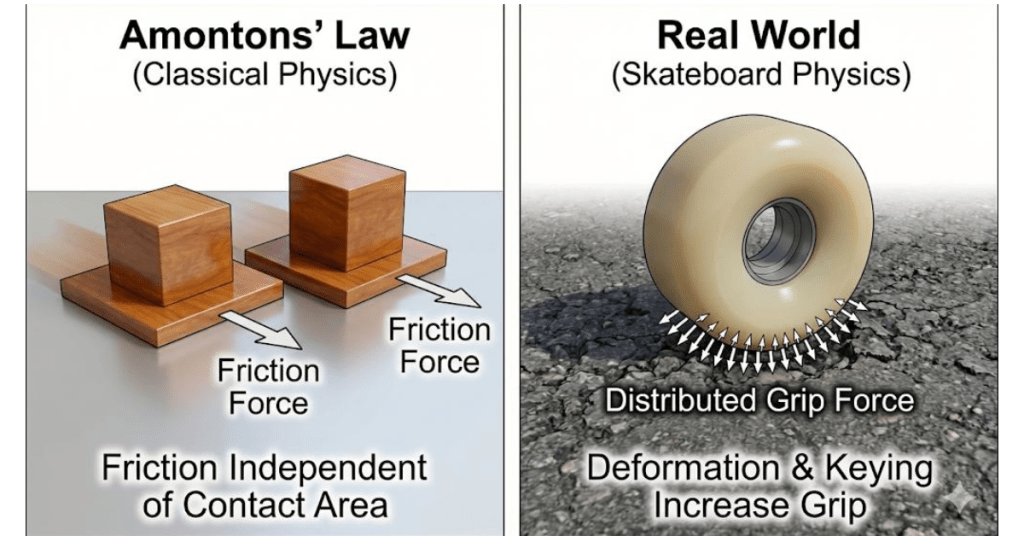
If you took high school physics, you might remember Amontons’ Law of Friction. This classical law states that friction is independent of surface area. In other words, a small block and a large block of the same weight should have the same friction.
So, why do wide wheels feel safer?
The classical model works for rigid solids, like wood on a table. But quality skateboard wheels are not rigid; they are made of viscoelastic urethane. This rubber deforms and flexes under your weight. When deformation happens, Amontons’ Law breaks down.
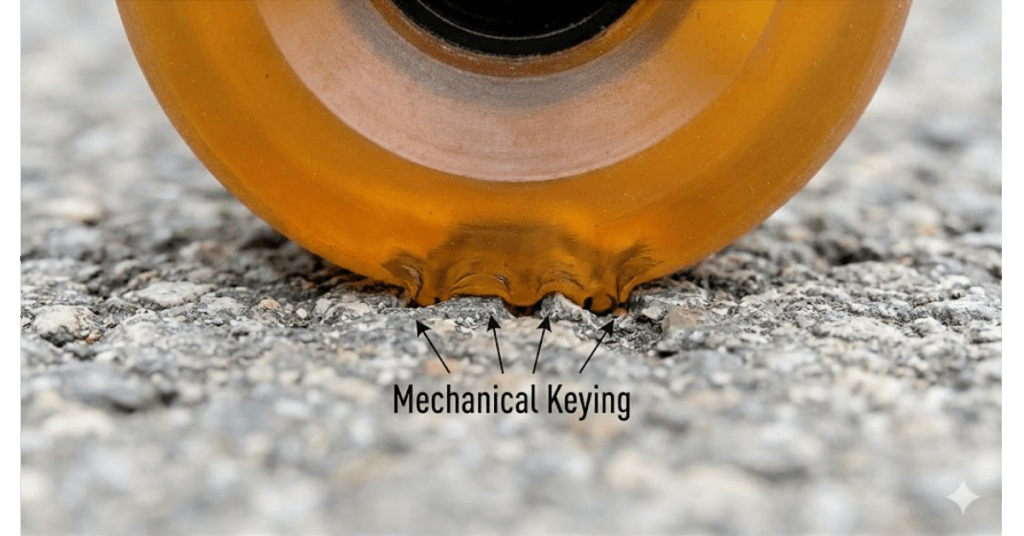
A wider contact patch allows the rubber to engage in Mechanical Keying. This is where the flexible rubber physically pushes into the microscopic peaks and valleys of the road surface, locking you in.
Technical Specs: 60mm Skateboard Wheels & The 45mm Contact Patch
This is where the “Safety” concept becomes a “Technical Specification.” If you are riding rough terrain or commuting, you specifically want to look for 60mm skateboard wheels with a contact patch of 45mm.
Why this specific ratio?
- The 60mm Diameter: It provides the rotational inertia needed to roll over rocks, cracks, and debris without pitching you forward.
- The 45mm Contact Patch: This is the “Gold Nugget” spec. A 45mm patch distributes your weight (vertical load) over a much wider area than a standard 30mm street wheel.
This distribution is critical. By spreading your weight, you prevent the rubber from overheating and failing (sliding) when you brake or turn hard. It transforms a “nervous,” vibrating ride into a “planted,” confident one.
Shear Stress: The Force That Causes Wipeouts
The true enemy of grip is Shear Stress. When you turn hard or slam on the brakes, you aren’t just pushing down; you are pushing sideways. These lateral forces try to rip the rubber off the pavement. Every rubber compound has a limit known as “Shear Strength.” Exceed it, and you slide.
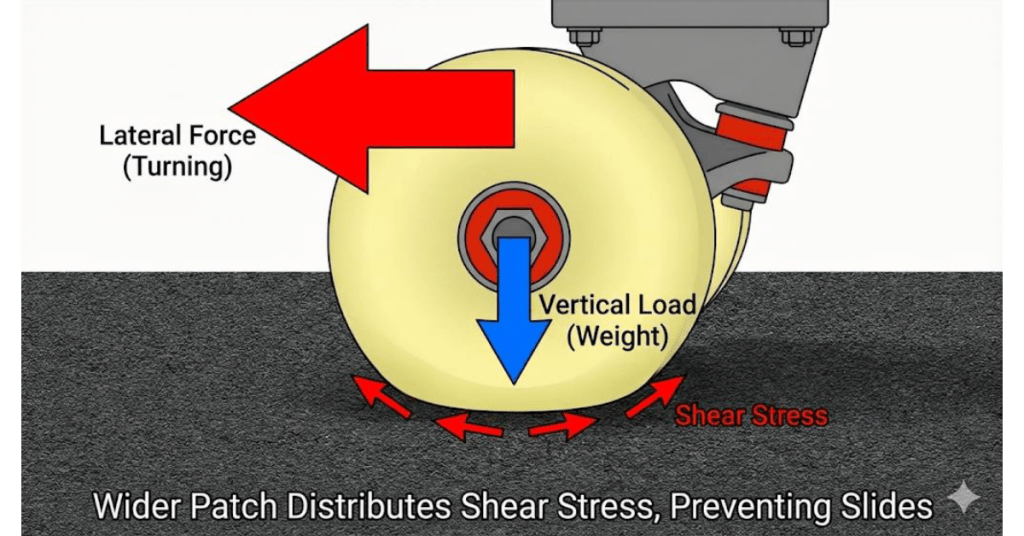
Narrow vs. Wide:
- Narrow Patch (30mm): High concentration of force. It is incredibly easy to exceed the shear limit of the rubber. This is great for technical power-slides but bad for commuting safety.
- Wide Patch (45mm): The same force is spread over a larger footprint. The stress per square millimeter is lower, keeping you well within the rubber’s safety limits and preventing the “washout” effect.
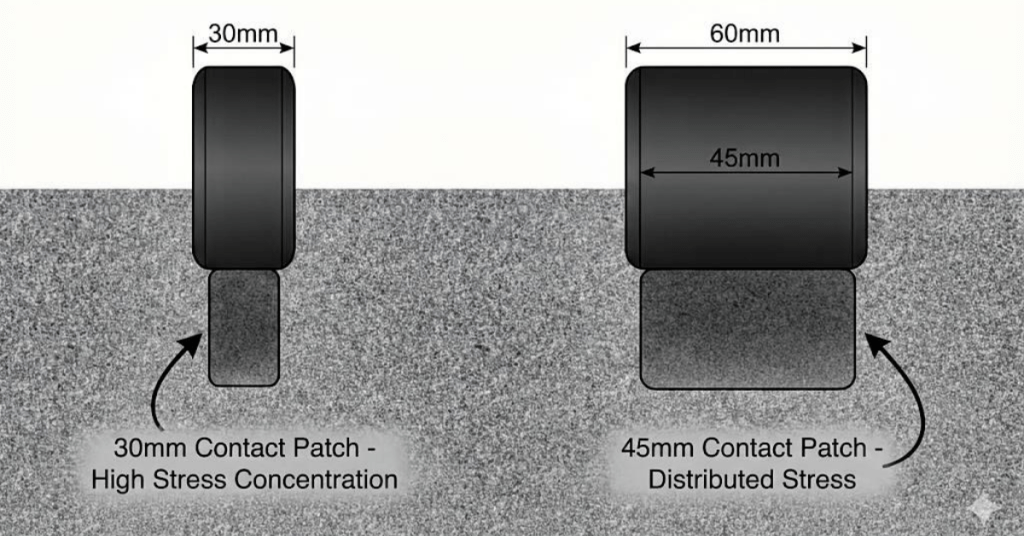
.
History of Grip: How a NYC Butcher Changed Skateboarding
Optimizing the contact patch isn’t a new idea. It actually started in a slaughterhouse in the 1920s. John F. Sipe, a butcher in New York City, kept slipping on wet floors and realized his flat rubber boots were the problem.
His solution? He carved tiny slits into the soles (now known as Siping). These cuts allowed the rubber to flex and “wipe” the floor dry, drastically increasing the contact patch’s efficiency.
Today, this principle is a standard for high-performance tires (like BFGoodrich). In skateboarding, we use the same principle: maximizing the effective rubber-to-road contact to manage water, debris, and lateral shear stress.
FAQs: Grip, Friction, and Safety
- If Amontons’ Law says friction is independent of size, why does a wide patch grip better?
“Amontons’ Law applies to rigid solids. Skateboard wheels are soft and deformable. A wider patch allows for better “Mechanical Keying” (interlocking with the road texture) and lowers localized Shear Stress, preventing the rubber from sliding.
- What is the ideal contact patch size for a beginner?
For maximum safety and stability, look for a contact patch between 40mm and 45mm. This is commonly found on “Cruiser” or “Filmer” wheels (often 56mm–60mm in diameter). When choosing a board for urban commuting, locking it securely is only half the battle; you also need to ensure your wheels are wide enough to handle the debris of city streets.
- Does a wider contact patch slow me down?
Technically, a wider patch creates more rolling resistance, which can slightly reduce top speed on perfectly smooth concrete. However, on real-world rough streets, the added stability allows you to ride faster with more confidence because you aren’t fighting for vibration control.
- Is the rubber compound more important than the patch size?
They work together. A soft durometer (like 78a) provides the “stickiness,” but the contact patch provides the “platform.” A soft wheel that is too narrow will deform too much and feel “mushy.” A wide contact patch supports the soft urethane, giving you the best of both worlds.